Elementary mathematics
Build understanding through counting, number sense, operations, and visual models.
The Cignition Content Library
Get closer to the instruction. See tutoring in action. Find perspectives and practical tools for your next decision.
Start with the learning
Browse our curriculum and standards documents, then open a sample lesson to explore the work for yourself.
Build understanding through counting, number sense, operations, and visual models.
Explore ratios, expressions, geometry, statistics, and connected mathematical ideas.
Examine content across algebra, geometry, and advanced mathematical concepts.
Explore foundational reading skills alongside language, vocabulary, and comprehension.
Examine reading, vocabulary, discussion, and evidence-based responses to text.
Explore analysis, clear expression, academic vocabulary, and purposeful use of evidence.
No lessons match those filters. Choose another subject or grade band.
Have a question about a standard or alignment? Talk it through with our team→
Inside a live session
Different subjects. Different session formats. A closer look at how tutors invite students into the work.
One-to-one · Foundational literacy
Watch a tutor support a kindergarten learner’s phonemic awareness and early decoding with visuals, hand motions, and targeted questions.
Watch for: prompts, student responses, and feedbackSmall group · Mathematics
See students explore fractions using digital models while their tutor facilitates questions, shared reasoning, and discussion.
Watch for: visual models, explanation, and peer thinkingWhite papers & strategic insights
Explore instruction, implementation, funding, and data. Find a useful starting point—or a different perspective on a question you’re already asking.
11 resources
PDFs, guides & videos
Short formInstruction
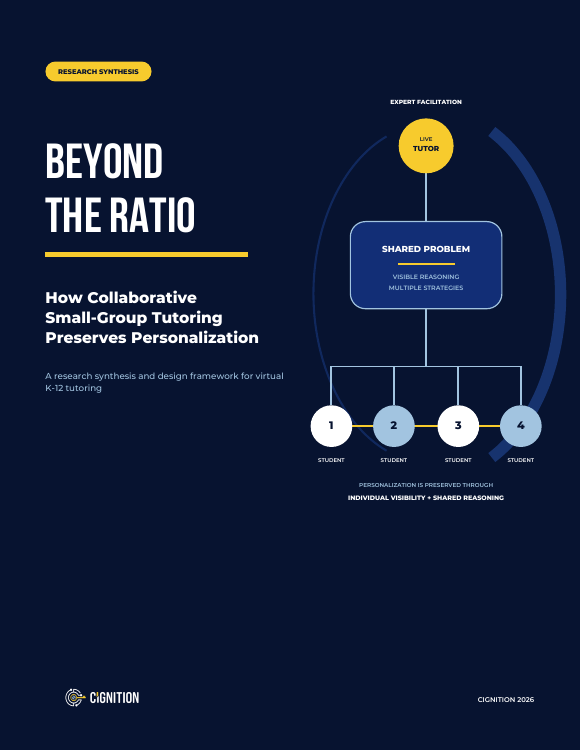
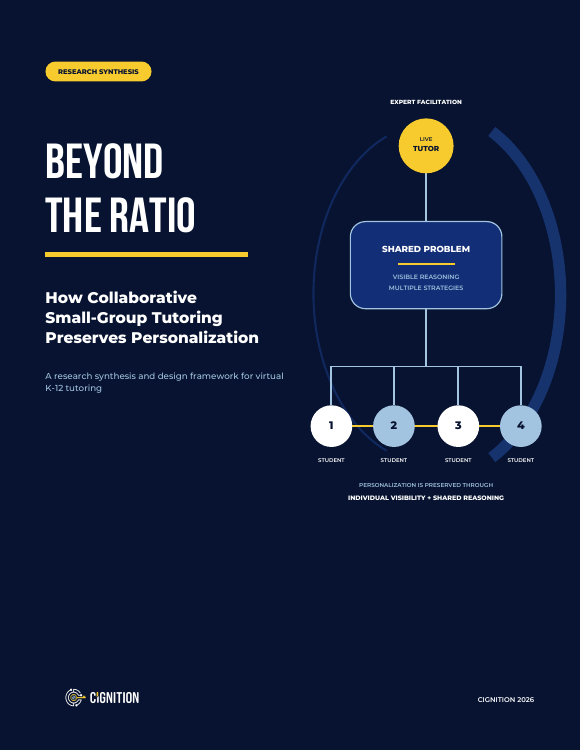
How Collaborative Small-Group Tutoring Preserves Personalization
Explore six design conditions that keep individual thinking visible while students reason and learn together.
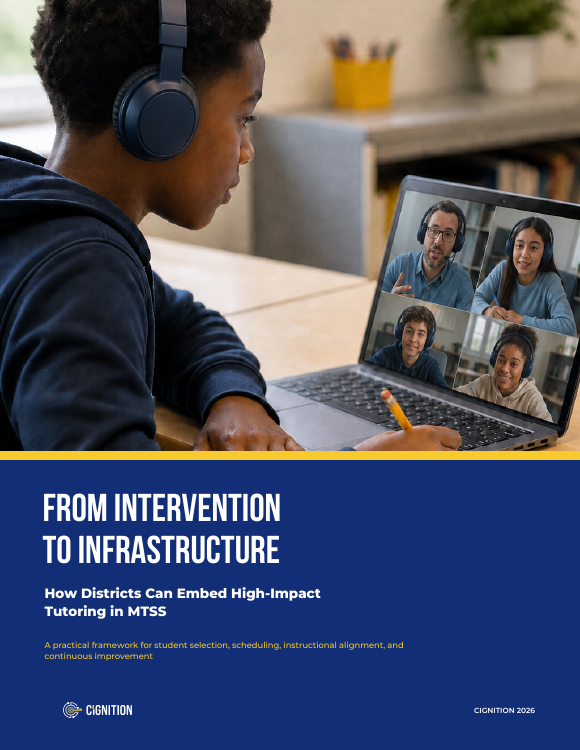
Short formImplementation & MTSS
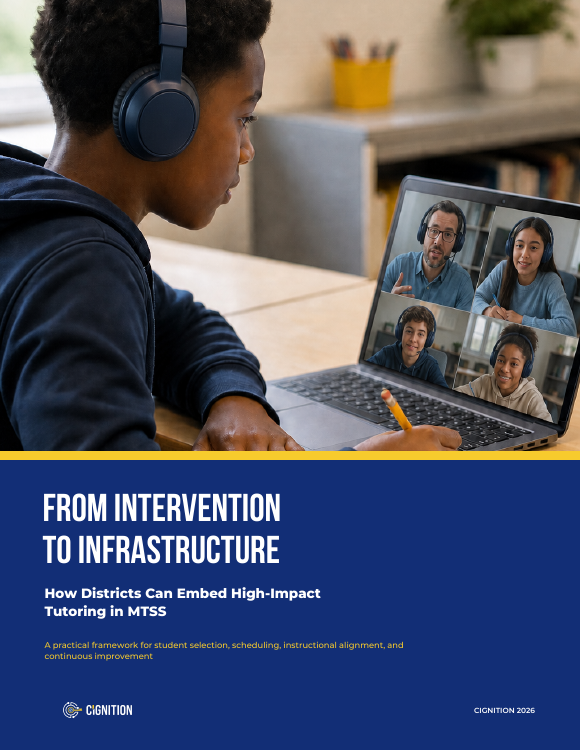
How Districts Can Embed High-Impact Tutoring in MTSS
A practical framework for student selection, scheduling, instructional alignment, and continuous improvement.
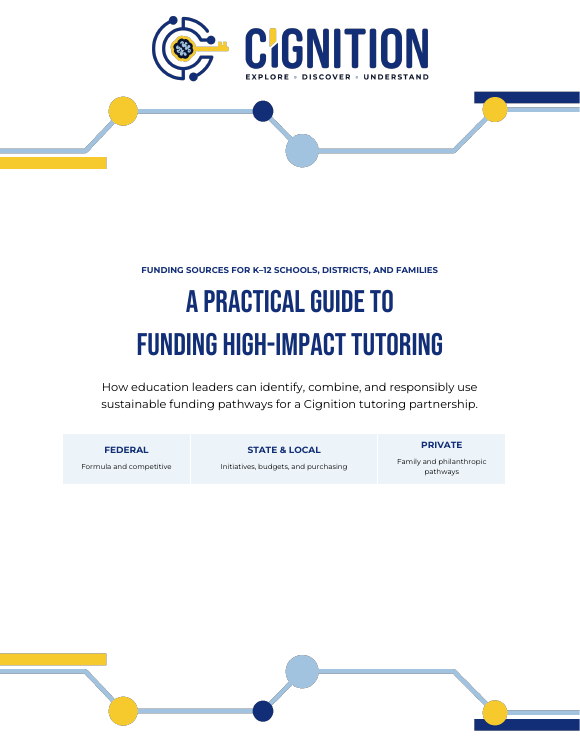
Short formFunding
Explore federal, state, local, family-directed, and philanthropic pathways—and the questions to ask as you plan.
Open accessInstruction
What Works, What Doesn’t, and the Road Ahead
Perspectives on tutoring design, common implementation challenges, and the changing tutoring landscape.
Open the white paper
Open accessEvidence & data
Implementing Outcomes-Based Contracting in Virtual Tutoring
A closer look at outcomes-based contracting, including an example from Denver Public Schools.
Open the white paperEarlier reference. Review current guidance when planning.
Open accessImplementation & MTSS
Consider the instructional and operational decisions involved in expanding a tutoring program.
Open the guideEarlier reference. Review current guidance when planning.
Instruction
Watch a tutor use visuals, hand motions, and questions to support phonemic awareness and early decoding.
Watch the sessionInstruction
See students use digital models, compare ideas, and discuss fractions with their tutor and peers.
Watch the sessionEvidence & data
Explore the views educators use to review participation, learning progress, and student feedback.
Watch the walkthrough
Open accessFunding
A dated reference on the federal funding landscape, planning considerations, and policy developments for 2025–26.
Open the playbookEarlier reference. Review current guidance when planning.
Open accessFunding
A Guide for K–12 Decision Makers
An earlier guide to funding approaches and sustainability considerations in the post-ESSER landscape.
Open the guideEarlier reference. Review current guidance when planning.
Try another topic, format, or search term.
Selected papers use a short form. Curriculum, sample lessons, and videos remain open. Earlier funding guides are dated references; visit our funding page to explore planning pathways.
Using data to drive instructional decisions
Learning progress matters. So does understanding whether students are getting the time, support, and opportunities to participate that a program intends.
Bring learning and implementation information together to guide discussion with your team.
The Teacher Dashboard walkthrough
Explore how school and district staff review attendance, participation, standards progress, and student feedback.
Review who attended and how much tutoring time students received. Compare actual participation with the plan before interpreting learning results.
Tutor observations and post-session reporting add context about student engagement and participation during instruction.
Student surveys offer another perspective on the tutoring experience, relationships, and how students see themselves as learners.
Use program assessments and mastery checks to examine understanding over time. These measures add instructional context and are distinct from state assessment proficiency.
Keep the questions coming
Explore how the program works, examine results, or talk through what tutoring could add for your students.